MISSION 01 / START HERE
Buy the bin second.
A storage container is the last step, not an emotional support purchase.
Sort the contents.
Group by the tasks these things support.
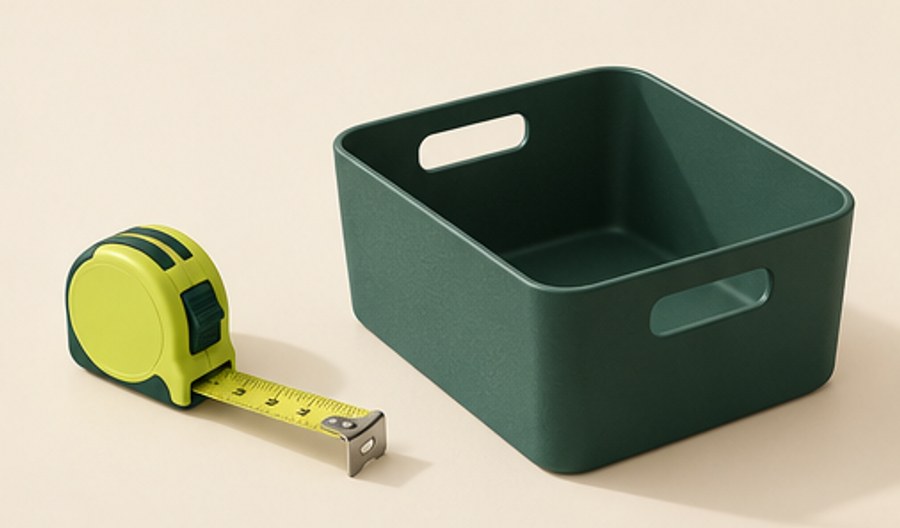
Measure the space.
Check the opening, obstacles, and usable interior.
Test before buying.
Try a box you own through several normal uses.
The full mission briefing
01 Your mission
Make one storage space easier to use without buying a solution to a problem you have not measured. Pick a drawer, shelf, or cabinet. Keep the project small enough that you can put everything back today.
02 Sort before you shop
Remove only the contents of that space. Group items by the task they support: making coffee, packing lunch, paying bills. Separate things you actually use from duplicates, broken items, and objects that belong elsewhere. Do not make decisions for someone else’s belongings. Return those to their owner for a decision.
03 Measure the useful space
Measure the narrowest internal width, depth, and height. Account for hinges, pipes, drawer slides, and the lip of the opening. A container that fits inside a cabinet can still be impossible to pull through its door. Write down the dimensions of the opening as well as the interior.
04 Prototype with what you own
Use a clean shoebox, food container, or folded cardboard divider to test your groups. Try the arrangement through several normal uses before ordering anything. If you keep lifting one box to reach another, the layout needs work. Daily-use items should be reachable without dismantling a small archaeological site.
05 When a purchase earns its place
Buy only when you can finish this sentence: “This will hold these items, fit this measured space, and remove this specific inconvenience.” Compare external dimensions for fit and internal dimensions for capacity. Handles and tapered walls use space. Avoid buying a matching set if only two pieces solve the problem.
06 Stopping point
The contents fit, you can retrieve them, and you can put them away. Matching labels are optional. Your drawer has not applied for a magazine cover.
Options that earn their space.
Try what you own first. These are specification-based options, not personally tested products. Each Amazon link below is a paid link.
Homecor expandable organizer
A cutlery layout that can expand within a measured drawer.
Collapsed footprint: 13.2 × 14.5 in; listed height: 2 in. Allow closing clearance.
the minimum footprint is too large or preset compartments do not suit your utensils.
Specifications and limitations
A MEASUREMENT EXAMPLE / NOT PERSONALLY TESTED
For cutlery: Homecor expandable organizer
An expandable tray can adapt to a drawer, but it still has a minimum footprint. The linked Black Homecor organizer lists a collapsed width of 13.2 inches and depth of 14.5 inches, expanding to 22 inches wide and 19 inches deep. Its listed height is 2 inches. Your drawer needs usable space beyond the tray height for utensils and closing clearance.
Measure the narrowest internal width and depth, then sketch the collapsed footprint on paper. Expand only as far as the usable drawer allows. The largest advertised size is an upper limit, not a promise that the organizer fits every kitchen drawer.
The listing describes removable knife inserts and anti-slip pads that must be installed before use. We have not tested blade compatibility, sliding resistance, or durability. Follow the installation instructions; knife storage should remain inaccessible to children, and the organizer itself is not a child-safety lock.
Skip it if: the collapsed footprint is too large, your drawer is too shallow, or the preset cutlery compartments do not suit what you actually store. Existing trays or separate small containers may be a better use of space. Expandable does not mean exempt from measuring.
Paid link: we may earn a commission on qualifying purchases. As an Amazon Associate I earn from qualifying purchases.
View Homecor organizer on Amazon (paid link) ↗Measure before buying and make room for normal use.
Try the storage fit check →Your junk drawer needs management. →